
IsoFLUX – Integrating Contaminant Mass Flux and Isotope Analysis
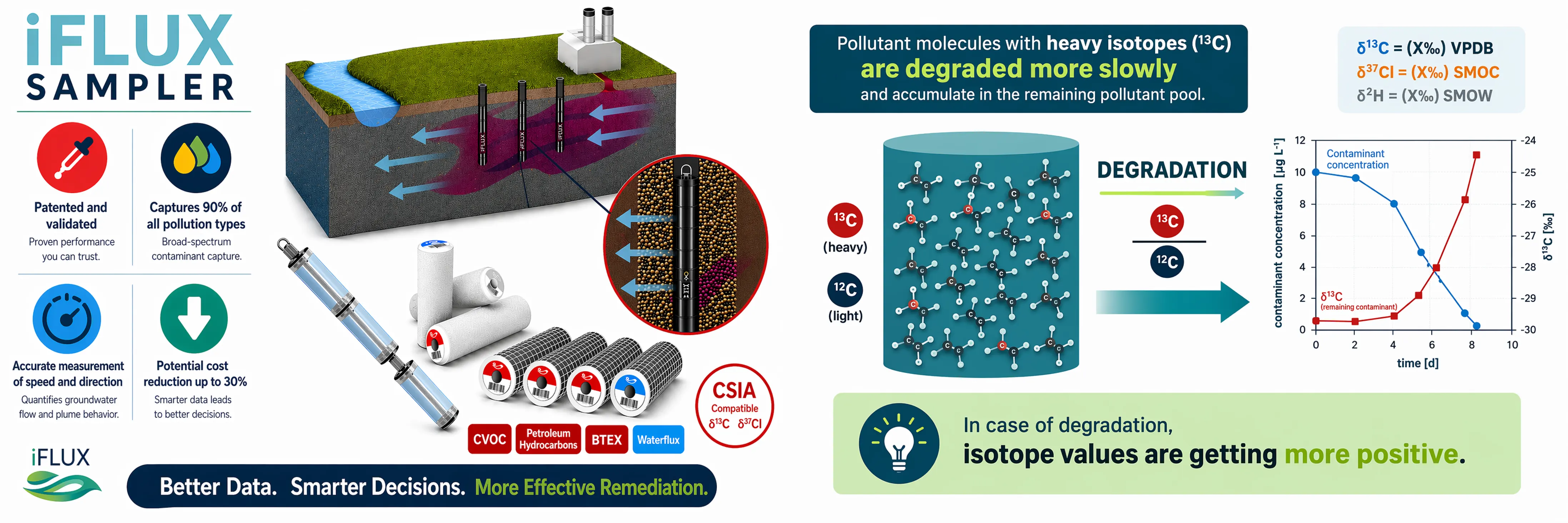
IsoFLUX: Measure Mass Flux and Biodegradation in a Single Deployment
Traditional monitoring programs often rely on concentration measurements from monitoring wells, which can miss important information about contaminant migration and degradation. IsoFLUX combines passive mass flux measurements with compound-specific isotope analysis (CSIA) to provide a more representative assessment of contaminant loading, transport, and in situ biodegradation.
By integrating contaminant mass flux data with isotopic enrichment trends, IsoFLUX helps practitioners determine whether natural attenuation or remedial activities are effectively reducing contaminant mass discharge.
WHY CONCENTRATION DATA ALONE CAN BE MISLEADING
WHAT IS ISOFLUX?
IsoFLUX combines passive groundwater and contaminant flux measurements obtained using iFLUX technology with compound-specific isotope analysis (CSIA) to simultaneously evaluate groundwater flow, contaminant mass flux, isotopic composition, and changes in degradation pathways.
KEY BENEFITS
- Time-integrated sampling
- Multiple lines of evidence
- Quantifies contaminant mass discharge
- Evaluates biodegradation processes
- Optimizes remediation strategies
- Supports regulatory closure
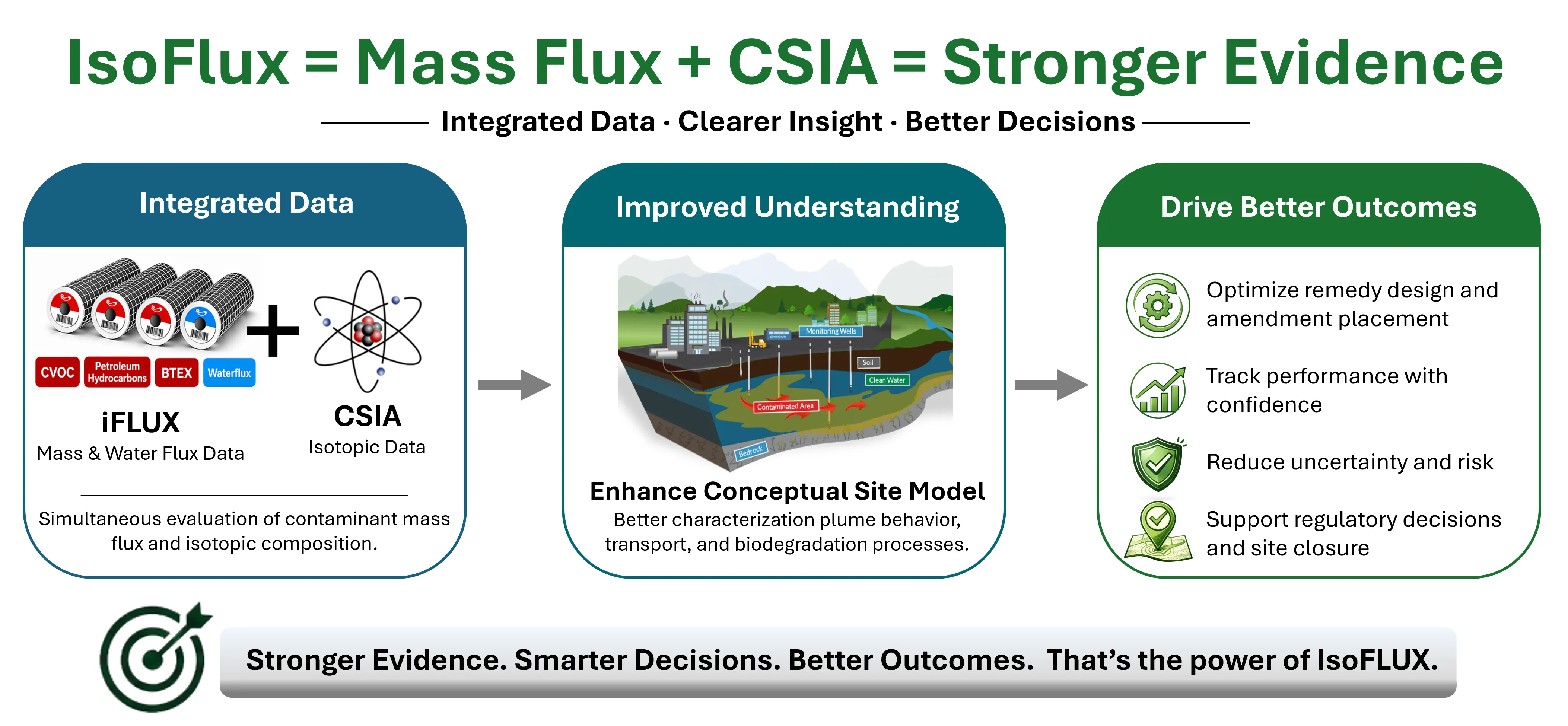
IsoFLUX → Mass Flux + CSIA = Stronger Evidence
Together, mass flux and CSIA make IsoFLUX a powerful one-two punch for remediation performance monitoring:
- Mass flux quantifies how much contaminant mass is still moving.
- CSIA shows that contaminants are being destroyed, not just diluted.
Smarter Decisions, Better Outcomes
By integrating molecular-scale evidence (CSIA) with plume-scale transport data (mass flux), IsoFLUX provides project teams with a dataset that goes beyond concentrations—capturing the real flow of contaminants and their fate in the environment.
IsoFLUX allows site managers to:
- Differentiate dilution from destruction
- Quantify reductions in mass discharge
- Build stronger cases for monitored natural attenuation (MNA) or remedy effectiveness
- Provide regulators with a clear, defensible line of evidence
Bottom line: CSIA tells you what’s happening at the molecular level. Mass flux shows you how much contaminant is moving. Together, IsoFLUX provides the clarity needed to demonstrate real progress toward remediation goals.
IsoFLUX Applications
IsoFlux can be applied throughout the project lifecycle - from site characterization to remedy optimization, performance monitoring, and site closure support.
|
|
|
|
|
|
|
|
|
|
|






Target Contaminants & Isotope Systems
Tersus supports CSIA investigations for a broad range of contaminants using multiple stable isotope systems tailored to site-specific objectives.
| Contaminant Group | Common Isotopes | |
| Chlorinated Solvents | δ¹³C, δ²H, δ³⁷Cl | |
| Petroleum Hydrocarbons | δ¹³C, δ²H | |
| MTBE & Fuel Oxygenates | δ¹³C, δ²H | |
| Explosives | δ¹⁵N, δ¹³C | |
| Nitrate | δ¹⁵N, δ¹⁸O | |
| Other Emerging Contaminants |
Additional isotope systems are available based on project objectives. |
Interested in Applying IsoFLUX at Your Site
Whether you are evaluating monitored natural attenuation, optimizing remediation performance, or supporting site closure, Tersus can help design and implement an IsoFLUX investigation tailored to your site objectives.
