
Compound Specific Isotope Analysis
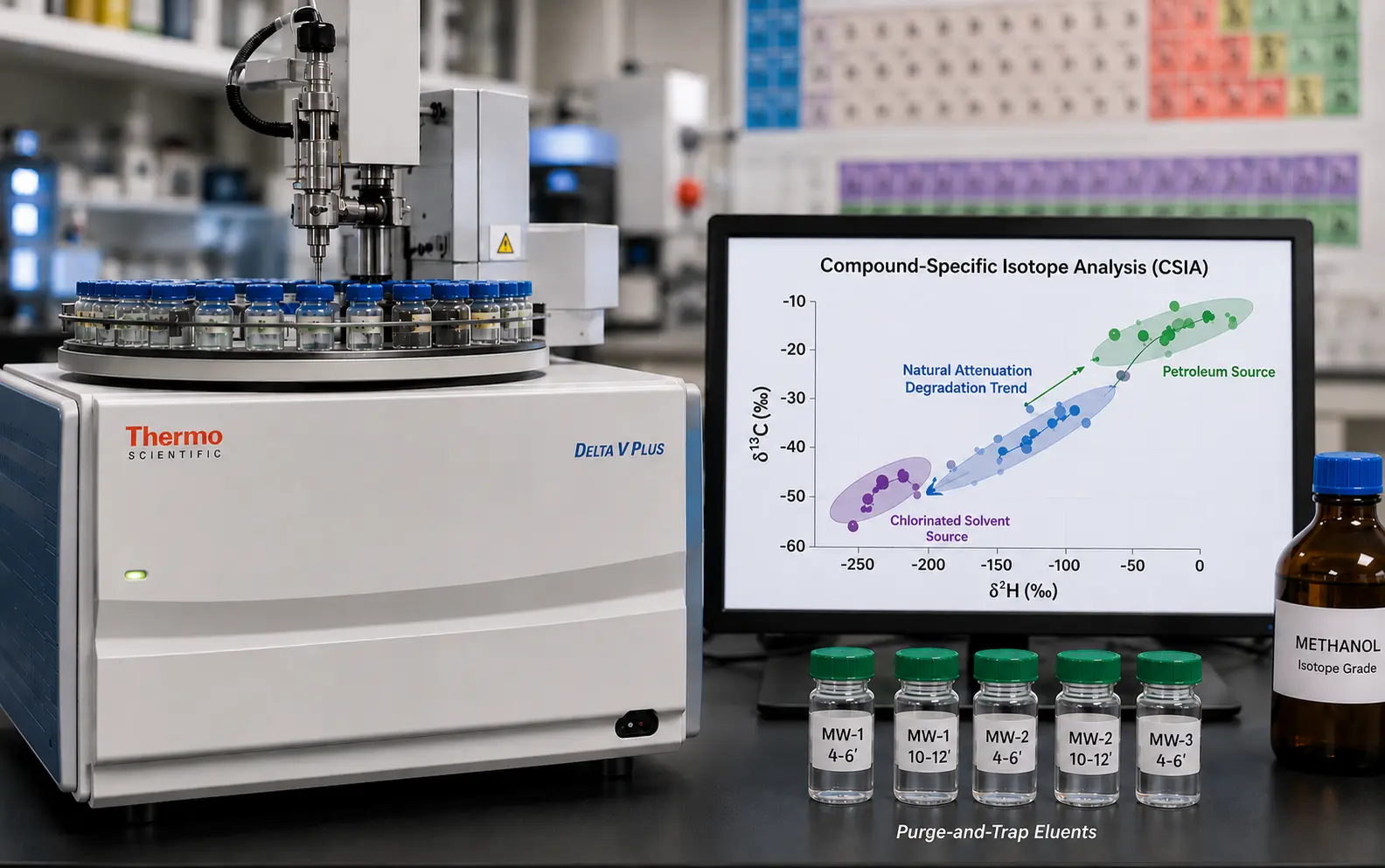
Environmental Forensics & Performance Monitoring
Compound-Specific Isotope Analysis (CSIA) uses naturally occurring stable isotopes to evaluate contaminant degradation, identify contaminant sources, and verify remediation performance.
By measuring changes in stable isotope ratios, CSIA provides powerful forensic evidence that helps practitioners distinguish between degradation processes, optimize remedial strategies, demonstrate treatment effectiveness, and support monitored natural attenuation (MNA) programs.
Unlike conventional concentration data alone, CSIA can differentiate contaminant destruction from dilution, identify multiple contaminant sources, and provide direct evidence of both abiotic and biotic degradation processes. These capabilities make CSIA a valuable tool for site characterization, environmental forensics, remedy optimization, and long-term site management.
Tersus provides technical support for the strategic implementation, sampling, interpretation, and application of CSIA for contaminated site characterization, remediation performance monitoring, and environmental forensic investigations.
Why Use CSIA?
Environmental practitioners use CSIA to answer critical questions regarding contaminant fate, transport, and remediation effectiveness.
|
|
|
|
|




How does CSIA work?
Many elements have naturally occurring stable isotopes. Carbon, hydrogen, chlorine, and many other elements occur naturally as both light and heavy isotopes at predictable abundances. During physical, chemical, and biological processes, these isotopes may fractionate, resulting in measurable changes in isotope ratios. CSIA quantifies these changes to evaluate contaminant fate, identify degradation pathways, and assess remediation performance.
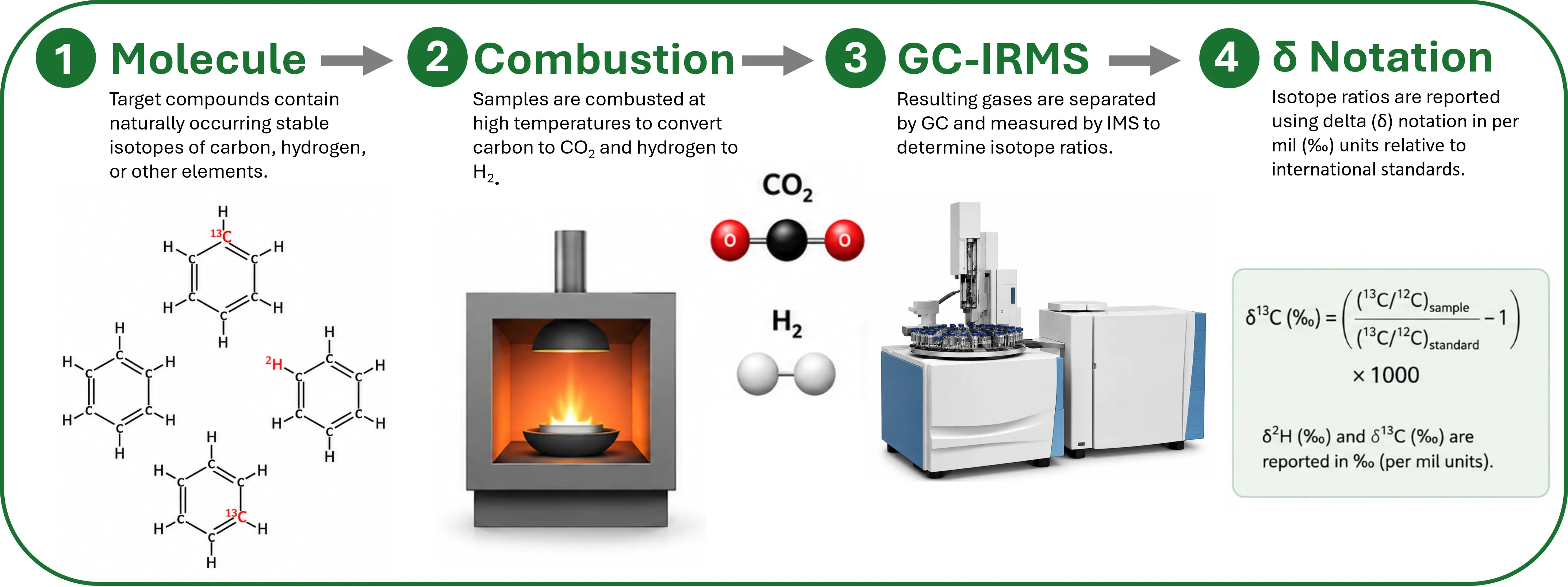
Note: The illustrated examples depict compounds containing carbon and hydrogen isotopes. Depending on the contaminants of concern, CSIA may also be performed using chlorine, nitrogen, sulfur, oxygen, and other element-specific isotope systems.
CSIA Applications
CSIA can be applied throughout the project lifecycle—from site characterization and environmental forensics to remedy optimization, performance monitoring, and site closure support.
|
|
|
|
|
|
|
|






Target Contaminants & Isotope Systems
Tersus supports CSIA investigations for a broad range of contaminants using multiple stable isotope systems tailored to site-specific objectives.
| Contaminant Group | Common Isotopes | |
| Chlorinated Solvents | δ¹³C, δ²H, δ³⁷Cl | |
| Petroleum Hydrocarbons | δ¹³C, δ²H | |
| MTBE & Fuel Oxygenates | δ¹³C, δ²H | |
| Explosives | δ¹⁵N, δ¹³C | |
| Nitrate | δ¹⁵N, δ¹⁸O | |
| Other Emerging Contaminants | Additional isotope systems are available based on project objectives. Contact Tersus to discuss site-specific applications. |
Example CSIA Interpretation
CSIA data are frequently evaluated using dual-isotope plots to assess contaminant degradation pathways and remediation performance. Changes in isotope enrichment trends can provide direct evidence of contaminant destruction and help distinguish between competing treatment mechanisms. The example below illustrates a transition from chemical oxidation to aerobic and anaerobic biodegradation following remedial treatment.

- CSIA distinguishes contaminant destruction from dilution.
- Dual-isotope plots can identify competing degradation mechanisms.
- Changes in isotope enrichment trends provide direct evidence of remediation performance.
- CSIA supports optimization of remedial strategies and long-term site management.
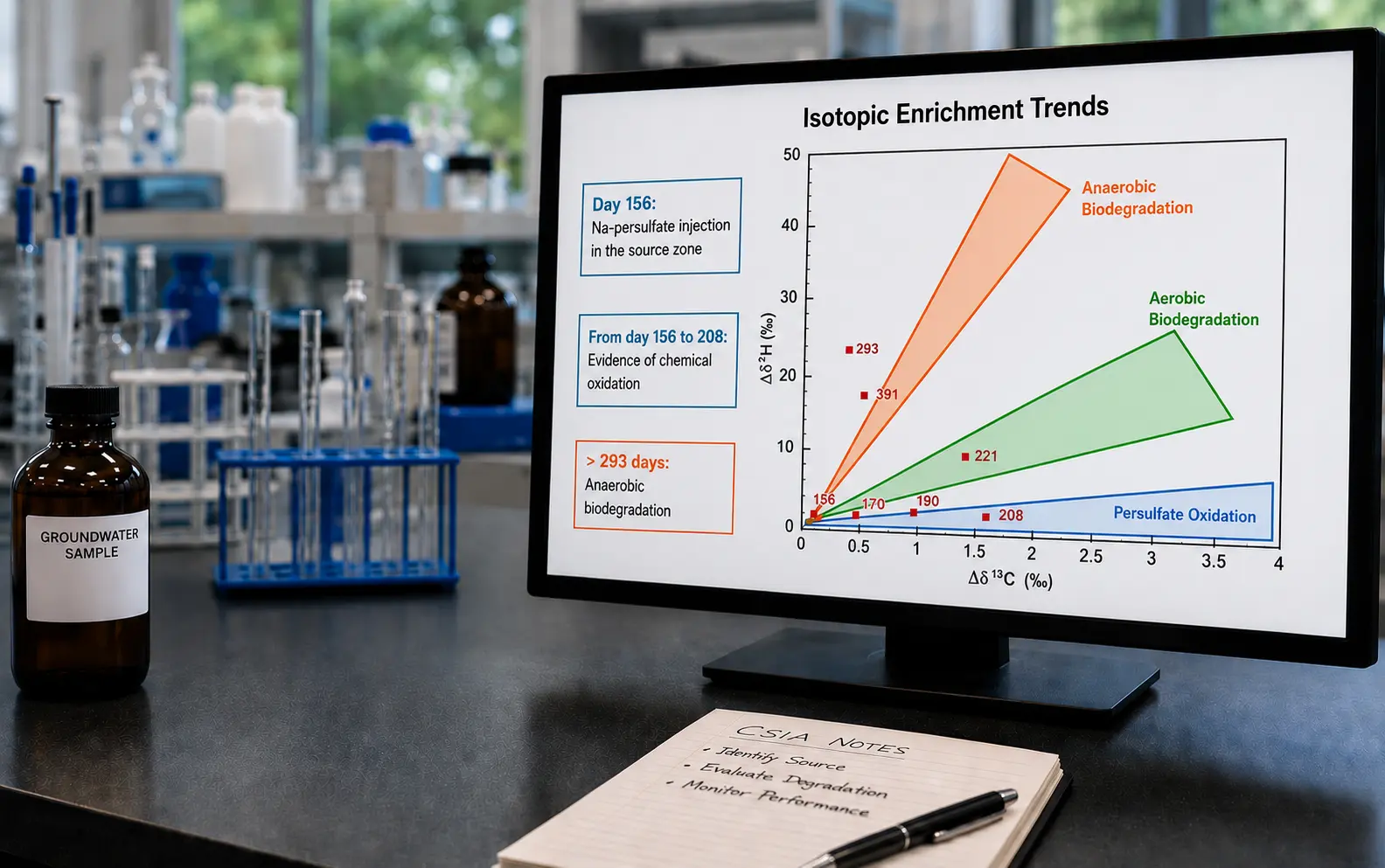
The example shown illustrates a transition from chemical oxidation to aerobic and anaerobic biodegradation following remedial treatment, demonstrating how CSIA can differentiate competing degradation pathways and verify treatment performance.
ADVANCING CSIA WITH ISOFLUX
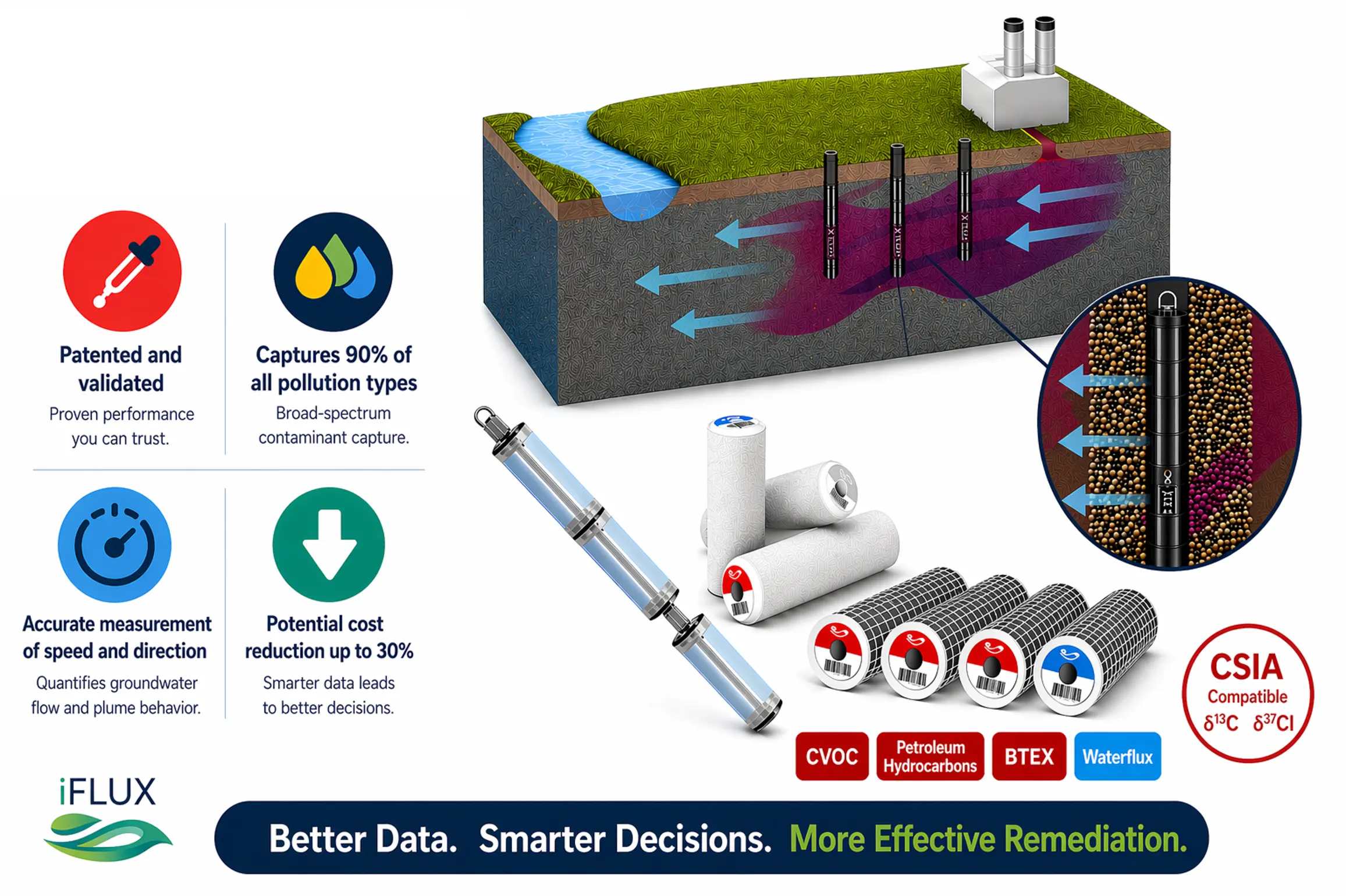
Conventional groundwater samples provide only a snapshot in time. IsoFLUX passive samplers integrate contaminant and isotope measurements over extended deployment periods, reducing short-term variability and providing a more representative assessment of remediation performance.
By combining CSIA with the iFLUX passive flux sampler technology, practitioners can:
- Evaluate isotope trends using time-integrated samples.
- Reduce uncertainty associated with temporal concentration fluctuations.
- Improve assessment of remediation performance and monitored natural attenuation.
- Obtain representative isotope data in low-yield or difficult-to-sample wells.
Benefits of CSIA
CSIA offers several important advantages compared to traditional concentration-based monitoring approaches and provides unique insight into contaminant fate and remediation performance.
- Distinguishes contaminant destruction from dilution. Changes in isotope ratios provide direct evidence of contaminant degradation, even when concentrations are influenced by groundwater mixing or amendment addition.
- Identifies degradation mechanisms. CSIA can differentiate between abiotic and biotic degradation pathways, providing insight into treatment processes and remedy performance.
- Supports multiple remedial technologies. CSIA can be applied to monitored natural attenuation, enhanced bioremediation, chemical oxidation, chemical reduction, and other remedial approaches.
- Integrates with conventional sampling programs. Sampling requirements are similar to standard VOC monitoring programs and typically require only additional sample containers for isotope analysis.
- Supports remedy optimization. Isotope trends provide valuable information for evaluating pilot studies, optimizing amendment dosing, and refining remedial strategies.
- Provides multiple lines of evidence. CSIA strengthens conceptual site models and supports regulatory decision-making throughout the remediation lifecycle.
TERSUS CSIA SERVICES
Tersus provides technical support to help clients successfully implement CSIA investigations for site characterization, environmental forensics, monitored natural attenuation, and remediation performance monitoring.
Our services include:
- Evaluation of site-specific CSIA applicability and project objectives.
- Development of sampling and assessment strategies.
- Integration of CSIA with molecular biological tools (MBTs), iFLUX, and conventional monitoring data.
- Support with sample collection protocols and laboratory coordination.
- Interpretation of isotope data and preparation of technical memoranda and reports.
- Evaluation of degradation pathways, source identification, and remediation performance.
- Technical discussions with project stakeholders and regulatory agencies.
- Recommendations to optimize remedial strategies and long-term monitoring programs.
ADDITIONAL RESOURCES
- EPA Guide for Assessing Biodegradation and Source Identification Using CSIA
https://clu-in.org/download/contaminantfocus/vi/A%20Guide%20for%20Assessing%20Biodegradation.pdf - ITRC Environmental Molecular Diagnostics Fact Sheets
- Aelion, C.M., Höhener, P., Hunkeler, D., and Aravena, R. (2009). Environmental Isotopes in Biodegradation and Bioremediation. CRC Press, 464 pages. ISBN: 978-1-56670-661-2.
- Bouchard, D., Hunkeler, D., Madsen, E.L., Buscheck, T., Daniels, E., Kolhatkar, R., DeRito, C.M., Aravena, R., and Thomson, N. (2018). "Application of Diagnostic Tools to Evaluate Remediation Performance at Petroleum Hydrocarbon-Impacted Sites." Groundwater Monitoring & Remediation, 38(4), 88-98.
