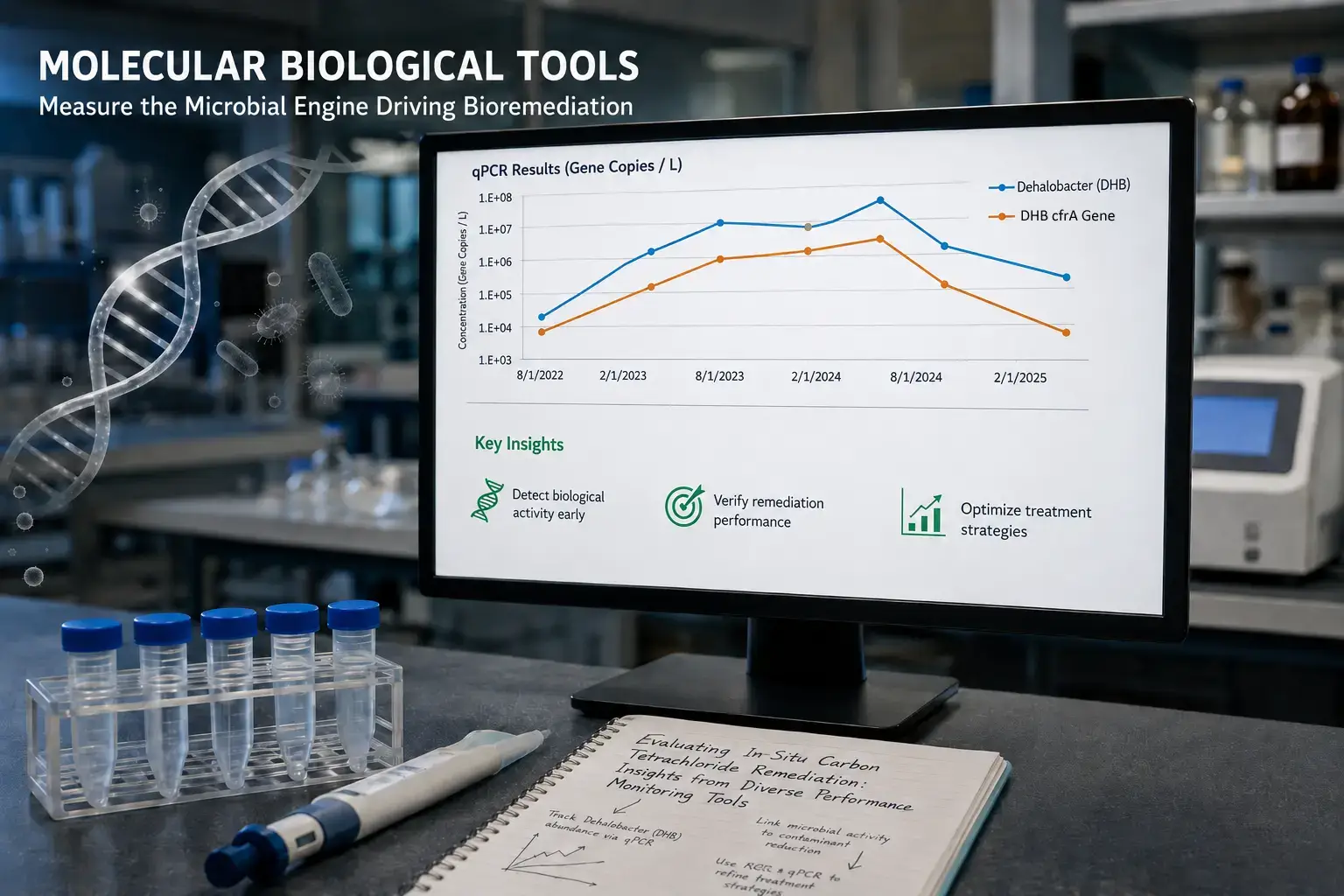
Molecular Biological Tools (MBTs)

What are Molecular Biological Tools?

Molecular Biological Tools (MBTs) are advanced DNA- and RNA-based analytical techniques used to characterize the microorganisms responsible for contaminant biodegradation in soil and groundwater. Unlike conventional groundwater chemistry, which provides indirect evidence of biodegradation, MBTs identify the microorganisms present and quantify the functional genes responsible for specific biodegradation pathways.

By evaluating microbial populations and their metabolic potential, MBTs help environmental professionals determine whether intrinsic biodegradation is occurring, identify factors limiting biological activity, and optimize remediation strategies. When combined with groundwater chemistry and Compound-Specific Isotope Analysis (CSIA), MBTs provide multiple lines of evidence to support remedial design, performance monitoring, and regulatory site closure.

Why Use Molecular Biological Tools?

MBTs provide valuable information throughout the life cycle of a remediation project by helping answer questions such as:

  • Are the microorganisms capable of degrading the contaminants present?
  • Which biodegradation pathways are active at the site?
  • Are microbial populations responding to remedial amendments?
  • Are environmental conditions favorable for continued biodegradation?
  • Is additional biostimulation or bioaugmentation warranted?
  • Is there sufficient evidence to demonstrate remediation progress and support site closure?

Common Applications

MBTs are routinely used to evaluate microbial activity associated with:

  • Petroleum hydrocarbon biodegradation
  • BTEX degradation
  • Chlorinated solvent reductive dechlorination
  • Chlorinated ethane degradation
  • Aerobic biodegradation
  • Anaerobic biodegradation
  • Sulfate reduction
  • Iron reduction
  • Methanogenesis
  • Perchlorate reductioesis

Application Guides

Different remediation applications require evaluation of specific microorganisms, microbial biomarkers, and functional genes. Select an application below to explore the molecular biological tools commonly used to evaluate biodegradation pathways and monitor remediation performance.

Chlorinated Ethene Reductive Dechlorination

Assess microorganisms and reductive dehalogenase genes responsible for the complete dechlorination of PCE, TCE, cis-DCE, and vinyl chloride.

Common Biomarkers

  • Dehalococcoides spp. (16S rRNA)
  • Representative Reductive Dehalogenase Genes
    • vcrA (Vinyl Chloride Reductase)
    • bvcA (BAV1 Reductase)
    • tceA (Trichloroethene Reductase)
    • pceA (Tetrachloroethene Reductase)
  • Dehalobacter spp. (16S rRNA)
  • Geobacter
  • Desulfitobacterium

Chlorinated Ethane Reductive Dechlorination

Evaluate microbial populations associated with the biodegradation of chlorinated ethanes, including 1,1,1-TCA and related compounds.

Common Biomarkers

  • Dehalobacter spp. (16S rRNA)
  • Representative Reductive Dehalogenase Genes
    • dcaA (1,2-Dichloroethane Reductase)
    • dcrA (1,1-Dichloroethane Reductase)
    • cfrA (1,1,1-Trichloroethane Reductase)*

*Dual-functional gene associated with the reductive dechlorination of chloroform to DCM and 1,1,1-TCA to 1,1-DCA.

Chlorinated Methane Reductive Dechlorination

Evaluate microbial populations associated with the biodegradation of chlorinated methanes, including Chloroform (CF) and Carbon Tetrachloride (CT).

Common Biomarkers

  • Dehalobacter spp. (16S rRNA)
  • Representative Reductive Dehalogenase Genes
    • cfrA (Chloroform Reductase)*
    • ctrA (1,1,1-Trichloroethane Reductive Dehalogenase)**

*Dual-functional gene associated with the reductive dechlorination of chloroform to DCM and 1,1,1-TCA to 1,1-DCA.
**While primarily an ethane gene, ctrA can also dual-function to reduce carbon tetrachloride (CT) to chloroform (CF) in some Dehalobacter strains.

Aerobic Hydrocarbon Biodegradation

 Evaluate microorganisms and functional genes associated with the aerobic biodegradation of BTEX compounds, polycyclic aromatic hydrocarbons, MTBE, TBA, and related petroleum hydrocarbons.

COMMON BIOMARKERS

  • Representative Oxygenase and Dioxygenase Genes
    • Toluene Monooxygenase
    • Toluene Dioxygenase (tobD)
    • Xylene Monooxygenase
    • Naphthalene Dioxygenase (nahAc)
  • Catechol 2,3-Dioxygenase (C23O)
  • Methylibium petroleiphilum PM1 (16S rRNA)
  • HIBA Mutase (hcmA)
  • Tert-Butyl Alcohol Hydroxylase (mdpJ)

Anaerobic Hydrocarbon Biodegradation

Evaluate microorganisms and functional genes associated with the anaerobic biodegradation of petroleum hydrocarbons, including BTEX compounds.

Common Biomarkers

  • Benzylsuccinate Synthase (bssA)
  • Anaerobic Benzene Carboxylase (abcA)
  • Benzoyl-CoA Reductase (BCR)
  • Geobacter spp.
  • Sulfate Reducing Bacteria
  • Total Bacteria