
Enhanced Anaerobic Reductive Bioremediation
What Is Enhanced Anaerobic Reductive Bioremediation?
Enhanced anaerobic reductive bioremediation is an in situ remediation approach that stimulates naturally occurring microorganisms to biologically degrade chlorinated solvents in groundwater. The process begins by introducing biologically available organic amendments, commonly referred to as electron donors or organic substrates, into the subsurface. As these amendments are metabolized, dissolved oxygen and other competing electron acceptors are consumed, creating the anaerobic conditions necessary for reductive dechlorination. Through fermentation, electron donors generate hydrogen, which serves as the primary electron donor for organohalide-respiring microorganisms. Under these anaerobic conditions, chlorinated solvents act as electron acceptors and undergo sequential reductive dechlorination to less chlorinated daughter products and, ultimately, innocuous ethene. [1]
Emulsified vegetable oil (EVO) is a widely used long-term electron donor because it slowly ferments in the subsurface, providing a sustained source of organic carbon and hydrogen. Indigenous microorganisms first ferment the EVO to produce hydrogen, fatty acids, and other nutrients that support microbial activity. Specialized organohalide-respiring bacteria, including Dehalococcoides mccartyi, Dehalobacter, and Dehalogenimonas, then utilize the hydrogen generated during fermentation to sequentially dechlorinate chlorinated solvents such as PCE and TCE, ultimately transforming them to innocuous ethene under favorable site conditions.
Requirements for Successful Reductive Dechlorination?
Creating the right conditions supports microbes and biological processes that transform chlorinated solvents into harmless end products.
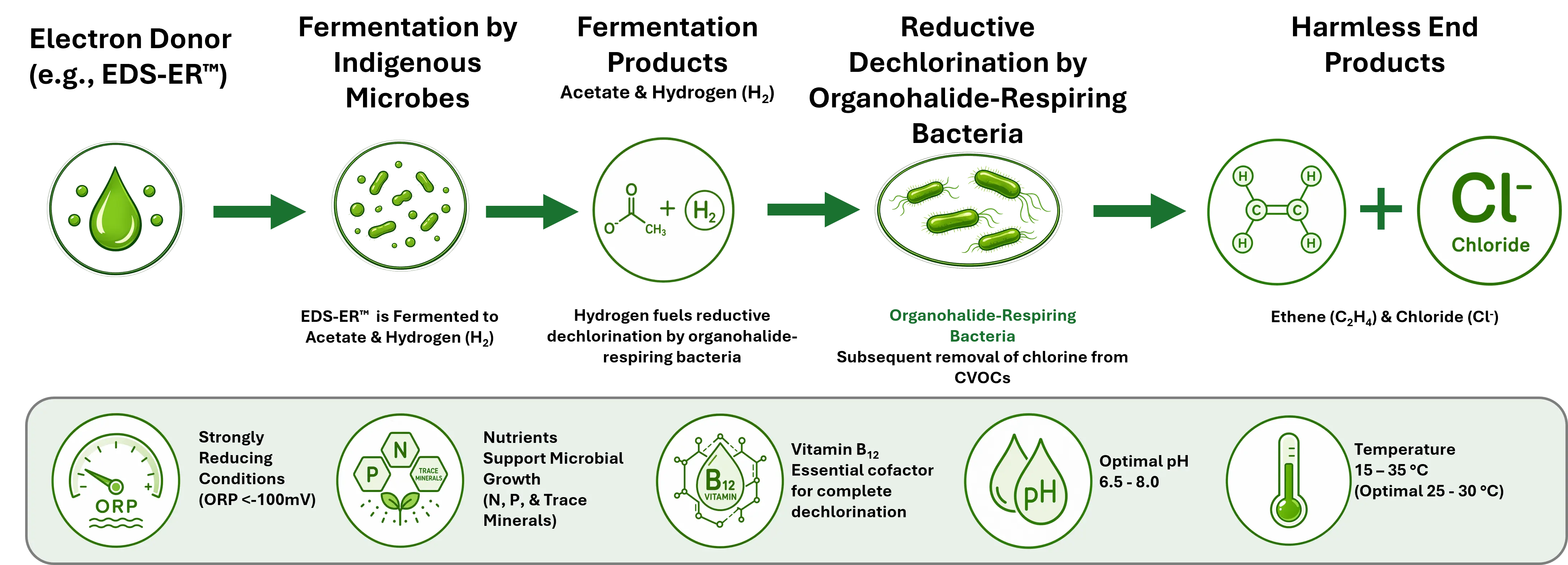
Simplified overview of enhanced anaerobic reductive bioremediation showing the relationship between electron donors, hydrogen production, reductive dechlorination, and complete detoxification of chlorinated solvents.
 The Right Electron Donor + Favorable Conditions + Active Microbes = Complete Dechlorination
Transforming chlorinated solvents into harmless end products.
Why Choose Enhanced Anaerobic Reductive Bioremediation?
- Provides sustained hydrogen production for long-term treatment
- Proven treatment for chlorinated solvents
- In situ treatment with minimal site disruption
- Compatible with bioaugmentation
Typical Applications
- Source Areas
- Dissolved Plumes
- Bedrock
- Low Permeability Zones
- Mixed Chlorinated Solvent Sites
Explore Related Technologies
Why Parter with Tersus?
- Over 40 Years of Remediation Expertise – Practical experience helping consultants, site owners, and regulators solve complex soil and groundwater remediation challenges.
- Innovative, Field-Proven Technologies – High-performance remediation products and treatment approaches designed for a wide range of contaminants and site conditions.
- Technical Collaboration – Practitioner-led guidance throughout technology selection, design, implementation, and performance monitoring.
- Responsive Customer Support – Knowledgeable assistance from budgeting and product selection through field implementation and project completion.
- Reliable Supply & Fast Delivery – Strategically located warehouses and dependable logistics help keep remediation projects on schedule.
- Committed to Your Project Success – We measure our success by helping clients achieve effective, practical, and cost-efficient remediation outcomes.
REFERENCE
- Groundwater, B.O., 2013, Introduction to In Situ Bioremediation of Groundwater. 542-R-13-018 December 2013. Office of Solid Waste and Emergency Response. Preparation of this report has been funded by the U.S. Environmental Protection Agency Office of Superfund Remediation and Technology Innovation (OSRTI) under Contract Number EP-W-07-078 to Tetra Tech EM Inc.
- Kaya Et al, 2019, Kaya, Devrim & Kjellerup, Birthe & Chourey, Karuna & Hettich, Robert & Taggart, Dora & Löffler, Frank. (2019). Impact of Fixed Nitrogen Availability on Dehalococcoides mccartyi Reductive Dechlorination Activity. Environmental Science & Technology.
- Stroo et al., 2013, Bioaugmentation for Groundwater Remediation, edited by Stroo, H.F., Leeson, A., Ward, C.H. HydroGeoLogic, Inc., Ashland, OR, USA
